


Table of Contents

Foreign companies can hire and pay employees in Armenia without setting up a local subsidiary. The most common option is to use an Employer of Record (EOR), which legally employs staff, processes salaries in Armenian dram, withholds applicable taxes and contributions, and submits reports to the State Revenue Committee (SRC).
This article explains how payroll works without a local entity, including employment contracts, tax obligations, payroll procedures, and the responsibilities of each party.
The legal employer is responsible for calculating salaries, withholding applicable taxes and contributions, and submitting payroll reports to the SRC. Monthly income tax reports and payments are generally due by the 20th of the following month.
Before hiring your first employee, account for these payroll responsibilities:
When employment is performed in Armenia, local employment and tax requirements may apply even if the company is based abroad. The legal employer and the party responsible for payroll depend on the hiring arrangement. Foreign companies can use an EOR or establish their own local entity, depending on their plans and obligations.
Foreign companies generally have three options: an EOR, independent contractors, or a staff augmentation provider. Each arrangement assigns employment and payroll responsibilities differently.
An EOR manages the main payroll tasks in Armenia, from preparing employment contracts to paying salaries and submitting tax reports. The process typically involves five steps.
The EOR prepares a written employment contract in Armenian, with a bilingual version available for foreign employees. The contract should specify the employee's position, responsibilities, start date, gross salary, payment schedule, working hours, annual leave, and termination conditions.
Mandatory digital contracting takes effect on 1 July 2027. Until then, using the digital system is voluntary, although digitally signed contracts are legally valid. Existing contracts that have not been entered into the system must be uploaded within the transition period ending on 30 June 2028. Special rules apply to certain foreign employees working in Armenia.
The EOR collects the employee's identification and employment details and submits the required registration information to the SRC. Registration is generally due by the end of the day before the employee starts work. If employment begins on the recruitment date, the deadline is 14:00 that day.Under Article 156 of the Armenian Tax Code, the standard employee registration requirement does not apply to foreign nationals without Armenian residence rights or residence status and stateless persons.
The provider also maintains the employee information needed for monthly payroll and tax reporting.
Each pay period, the EOR calculates gross salary, applicable deductions, and the employee's net pay in AMD. Payroll calculations may include:
The EOR should provide a breakdown of gross pay, deductions, and the final amount paid to the employee.
The EOR pays employees' net salaries in AMD at least once a month, no later than the 15th of the following month, in accordance with the Armenian Labor Code. It also submits monthly income tax reports to the SRC and transfers the applicable taxes and contributions. Monthly income tax reporting and payment are generally due by the 20th of the following month. Employees should receive payslips showing their salary and deductions.
The EOR maintains records of annual leave, public holidays, sick leave, and maternity leave. It also calculates applicable payments and processes changes to salaries, job responsibilities, and working conditions.
When employment ends, the EOR prepares the required documents, calculates final payments, and follows statutory notice and termination rules. Foreign companies should agree with the provider on how leave requests and employment changes will be approved and communicated. The employment laws in Armenia cover these requirements.
Armenian employers generally act as tax agents, calculating and withholding applicable payroll taxes and contributions rather than paying all of them as additional costs on top of salaries. Under an EOR arrangement, the provider handles these calculations and payments.
The main payroll items to consider in 2026 are:
For budgeting, distinguish between employee deductions and employer expenses. Income tax, applicable pension contributions, and military stamp duty are generally withheld from employees' income. Universal health insurance has separate funding and transitional arrangements, so companies should not treat the full premium as a standard employee deduction.
On October 29, 2026, the Armenian government approved draft amendments concerning the expansion of universal health insurance coverage to employees earning up to AMD 200,000 from January 2027. Under the proposed arrangement, the monthly AMD 10,800 premium would be divided between the state (AMD 4,400), the employer (AMD 4,400), and the employee (AMD 2,000). Foreign companies should account for potential additional employer costs and confirm the final legislation before applying the new rules.
Your total employment budget should account for gross salaries, applicable employer-funded costs, benefits, and EOR service fees. The income tax rate in Armenia provides further details on how employment income is taxed.
Foreign companies hiring in Armenia should watch for several common compliance risks:
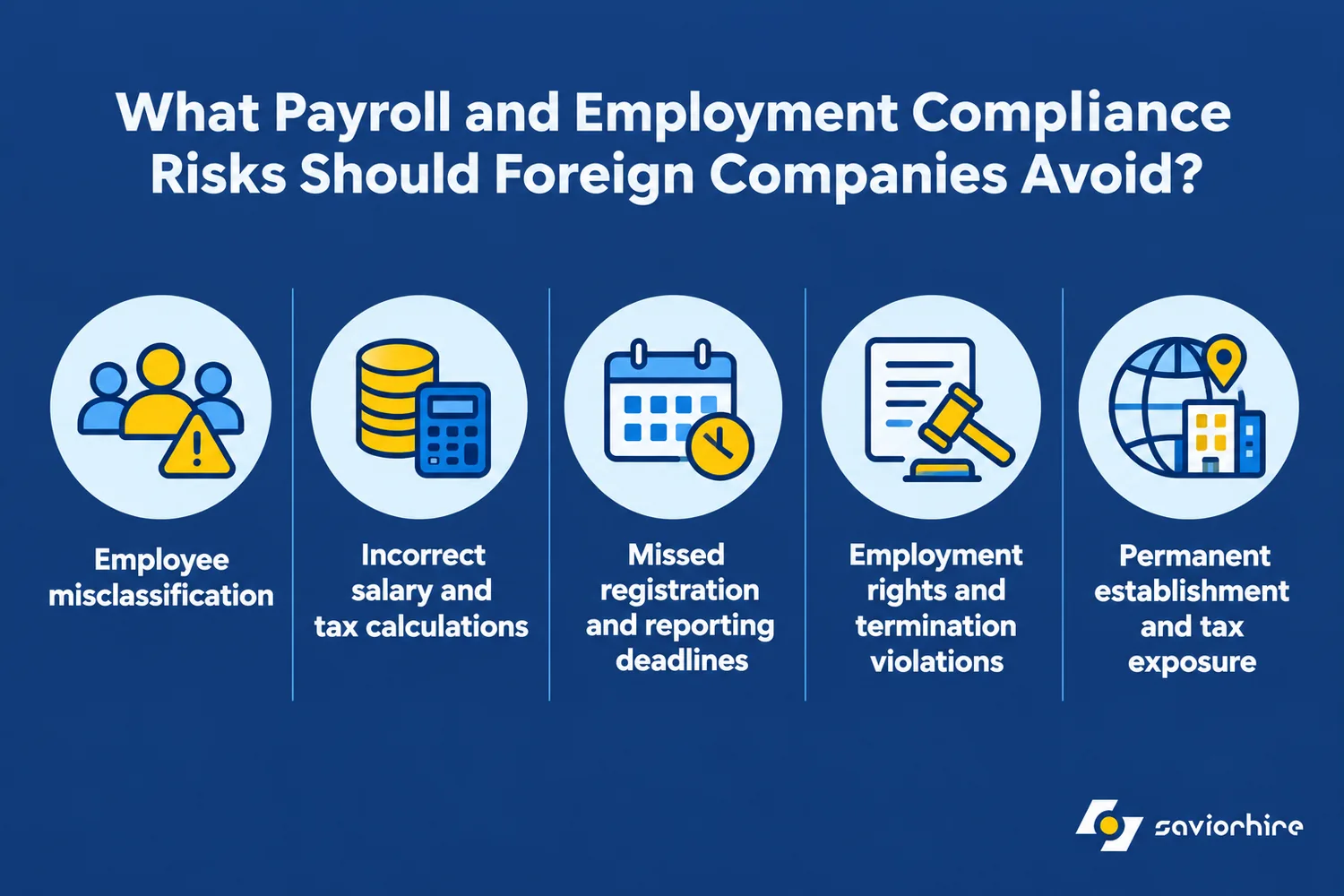
An EOR is often the simplest option for companies hiring their first employees in Armenia. Setting up a local entity may be more suitable for larger, long-term teams, while contractor agreements work for genuinely independent, project-based roles.
Consider your team size, hiring timeline, employment arrangements, and whether foreign employees need work authorisation. Before choosing an EOR provider, ask:
Companies hiring from Europe should also consider the requirements for European businesses employing staff in Armenia. Companies based in the Gulf region should account for the requirements that apply to GCC companies hiring in Armenia.
SaviorHire helps foreign companies hire employees in Armenia without establishing a local entity. Through our EOR payroll services, we handle the main employment and payroll responsibilities:
With SaviorHire managing payroll and employment administration, your company can hire in Armenia without building a local HR or payroll team.
Contact our team to discuss your hiring plans in Armenia.
Can a foreign company pay employees in Armenia without opening a local company?
How long does it take to set up payroll through an EOR in Armenia?
What taxes are deducted from salaries in Armenia?
Who pays income tax when an Armenian employee works for a foreign company?
Can a foreign company hire Armenian employees as independent contractors?
Does using an EOR eliminate permanent establishment risks in Armenia?

Hamlet Mirzoyan
Tech & iGaming Recruitment Expert, CEO of SaviorHire
Hamlet Mirzoyan
Tech & iGaming Recruitment Expert, CEO of SaviorHire
Hamlet Mirzoyan helps companies in the tech industry build strong and high-performing teams. With over a decade of experience in technical recruitment, he shares insights on hiring trends, talent strategies, and industry updates through the SaviorHire blog.
Need to hire faster?
Let’s talk