


Table of Contents

Asian companies have several options for hiring employees in Armenia. They can register a local company and employ staff directly, use an Employer of Record (EOR), engage independent contractors, or work with a staff augmentation provider. Each model has different costs, responsibilities, and setup requirements.
Armenia's tech sector continues to grow. According to the Finance Minister, the country's IT output grew by 25.6% in 2026.
This article compares the four hiring models and explains the employment laws Asian companies need to follow. It also covers hiring costs, time zones, and data protection.
Asian companies can hire in Armenia through their own local company, an Employer of Record (EOR), independent contractors, or a staff augmentation provider. Each option comes with different legal responsibilities, administrative work, costs, and suitability depending on the size and needs of your team.
For a small team without a local subsidiary, an EOR is often the fastest way to hire employees in Armenia. Some companies use this model initially and move employees to their own entity as their local operations grow.
You can register an Armenian limited liability company (LLC) with the State Register in one to two business days. However, registration is only the first step. You also need a resident director, monthly accounting and tax filings, and a corporate bank account that passes identity checks.
One potential benefit is access to the High-Tech Registry. Qualifying companies can pay a 1% turnover tax instead of ordinary corporate tax. They may also receive a refund of 60% of the personal income tax withheld from qualifying tech wages.
An EOR hires employees through its own Armenian entity and becomes their legal employer. It handles employment contracts, payroll, tax withholding, and statutory filings, while your company manages employees' daily work and performance.
You pay the EOR an ongoing service fee for each employee, while the provider handles local employment administration. However, your company cannot claim High-Tech Registry benefits in its own name because the EOR is the legal employer. When choosing a provider, compare local and global EOR services in Armenia to understand differences in pricing, payroll management, and local support.
Asian companies can engage Armenian specialists as independent contractors without establishing a local legal entity. Unlike employment relationships governed by Armenia's Labor Code, independent contractor arrangements are generally regulated by the Civil Code. Companies can work with contractors registered as individual entrepreneurs or operating through their own LLCs, using service agreements that define the scope of work, deliverables, and payment terms.
Contractors providing qualifying IT services may benefit from Armenia's 1% turnover tax rate, provided they meet the applicable eligibility requirements.
However, companies must distinguish genuine contractor relationships from employment. Fixed working hours, exclusivity, direct supervision, and company-provided equipment can indicate an employment relationship, even when the agreement identifies the worker as an independent contractor.
According to Vardanyan & Partners, misclassification can result in back taxes, penalties, and potential employee claims. The firm also identifies fines of AMD 50,000 for certain first-time employment registration or contract violations and AMD 100,000 for repeat violations within a year.
Staff augmentation providers help Asian companies access qualified Armenian specialists or dedicated teams without managing the entire recruitment process themselves. This option is particularly suitable for businesses that need additional technical expertise or want to expand their teams for specific projects.
Under this model, your company typically manages the specialists' day-to-day tasks, while the provider handles recruitment and other agreed administrative responsibilities.
The employment arrangement depends on the provider. Some staff augmentation companies employ specialists directly, while others combine staff augmentation with Employer of Record (EOR) services. Before signing an agreement, confirm who legally employs the specialists and who is responsible for employment contracts, payroll, taxes, and compliance.
Armenian employment law applies to anyone employed in the country, even if their employer is based in Asia. Several rules are changing in 2026, so companies hiring in Armenia should pay attention to the effective dates and updated requirements.
Every employee in Armenia must have a written employment contract under Article 84 of the Labor Code. The contract is signed in two copies, and the Armenian-language version takes legal precedence.
Amendments passed in February 2026 make the state digital contract system mandatory from 1 July 2027. Until then, using the system is voluntary. Contracts for foreign employees must initially be signed on paper and entered into the system within three months of receiving the employee's residence document. Fixed-term contracts are permitted only for specific purposes.
Employers must withhold taxes and contributions from employees' gross salaries and make the required payments each month. The main payroll items for 2026 are:
Pension contributions can vary depending on the employee's birth year. Confirm the applicable rates and amounts with the State Revenue Committee or your EOR before processing payroll.
The standard working week in Armenia is 40 hours, generally eight hours per day. Employees are entitled to a minimum of 20 working days of paid annual leave under a five-day workweek or 24 working days under a six-day workweek.
Overtime must be compensated at a minimum of 150% of the regular hourly rate. Work performed on rest days and non-working public holidays generally requires at least double pay, although compensatory paid time off may be permitted in certain circumstances.
When planning project schedules and deadlines, companies should account for Armenia's official non-working holidays as well as those observed in their home country. For detailed requirements, refer to the Armenian Labor Code.
Probation periods can last up to three months under the Armenian Labor Code. During probation, employers can terminate the contract if the employee is found unsuitable, provided they give three days' written notice.
Employers can dismiss staff only on grounds allowed by law. Redundancy requires at least two months' notice and severance equal to one month's average salary. Pregnant employees and those on certain types of leave have additional dismissal protections. Employees generally have two months from receiving the dismissal notice to challenge the termination in court.
Employers in Armenia must register new employees with the State Revenue Committee, generally before their first working day, and submit monthly payroll tax reports by the 20th of the following month. When hiring through an Employer of Record (EOR), the provider handles these registration, payroll, and reporting obligations as the legal employer.
For foreign nationals, amendments to Armenia's Law on Foreigners took effect on November 1, 2026, introducing changes to residence and employment authorization procedures, including a quota-based system. However, certain provisions, including the new Work Entry Visa, have separate implementation dates. Armenia's Migration and Citizenship Service provides additional information about the changes to residence procedures. You can also read SaviorHire's Armenia work permit guide for more details.
This article provides general information, not legal advice. Companies should confirm the applicable employment and immigration requirements with a qualified Armenian legal professional before hiring.
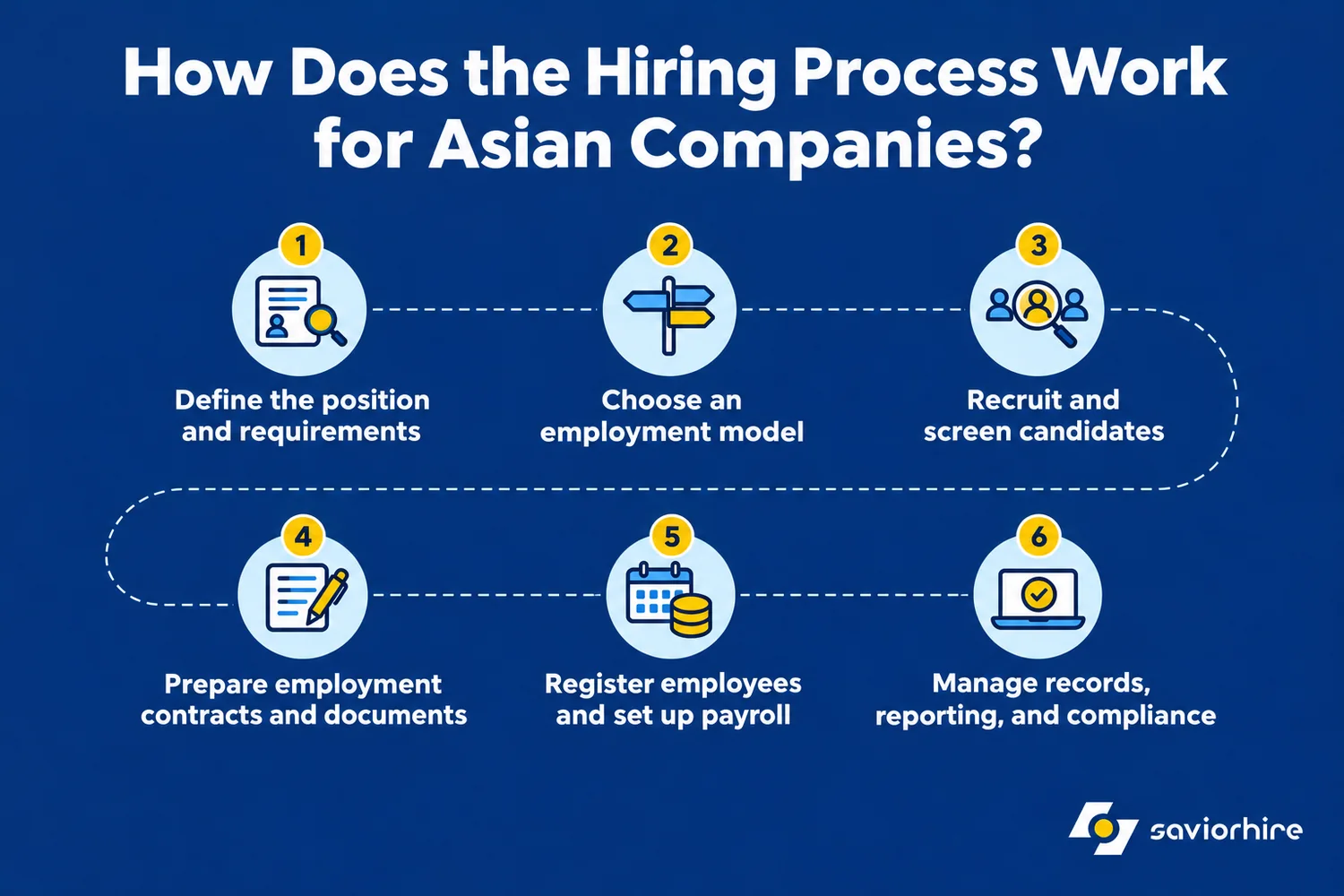
Hiring employees in Armenia involves more than finding suitable candidates. Asian companies must also choose an employment model, prepare local documentation, and arrange payroll and tax reporting. The process usually follows six steps.
Start by outlining the role, required technical skills, experience level, salary range, and reporting structure. Check current Armenian salary expectations for the position so your offer is competitive. Also decide whether the employee needs English for daily communication with your team or clients.
Decide how you will legally engage the specialist. You can register an Armenian company and employ staff directly, use an Employer of Record (EOR), or hire a genuinely independent contractor. If you need several specialists without establishing a local entity, staff augmentation is another option. Consider the costs, administrative responsibilities, and legal risks of each arrangement before proceeding.
Advertise the vacancy through local job boards, professional networks, or an IT recruitment agency. Review candidates' technical experience, English proficiency, and ability to work across time zones. For software roles, technical interviews and practical assessments can help verify skills before making an offer.
For employees, prepare a written contract that meets Armenian Labor Code requirements. It should cover job responsibilities, salary, working hours, leave, probation, and termination conditions. The Armenian-language version is legally important, so have it prepared or reviewed by a local specialist. Collect the employee's identification and other documents needed for registration.
Register employees with the State Revenue Committee and set up monthly payroll. This includes calculating gross and net salaries, withholding income tax and applicable pension and health insurance contributions, and arranging payments in AMD. An EOR handles these tasks when it acts as the legal employer.
Keep employment contracts, payroll records, leave information, and other required employee documents up to date. Submit tax and payroll reports by the applicable deadlines and update records when salaries or employment conditions change. You must also follow Armenian rules on working hours, annual leave, termination, and personal data protection. If you use an EOR, clarify which compliance tasks it handles and which remain your responsibility.
When hiring in Armenia, Asian companies should consider the following practical factors:
SaviorHire helps companies in Vietnam, Thailand, Indonesia, Malaysia, the Philippines, India, and Cambodia, China hire Armenian specialists without establishing a local entity. Whether you need one developer or an entire technical team, you can add Armenian employees to your existing operations.
SaviorHire is a Yerevan-based IT recruitment and EOR company. Through its EOR service, we handle Armenian employment contracts, AMD payroll, tax withholding, benefits administration, and offboarding. Companies that need help finding specialists can also use our recruitment and staff augmentation services, backed by a database of more than 50,000 pre-screened professionals
SaviorHire also offers transparent EOR pricing with no deposits, no onboarding or offboarding fees, and no hidden charges. This helps companies plan their employment budgets with greater confidence and avoid unexpected service costs.
From hiring individual developers to building larger remote teams, we can help manage the recruitment and employment responsibilities involved.
Talk to SaviorHire about your hiring plans in Armenia.
Can an Asian company hire employees in Armenia without opening a local company?
Can Asian companies employ remote workers in Armenia?
How much does it cost to hire an employee in Armenia?
Do Asian companies have to pay Armenian payroll taxes when hiring locally?
Can Asian companies hire Armenian software developers remotely?
How long does it take to hire an employee in Armenia?
What is the difference between an EOR and a recruitment agency?
Can an Asian company transfer an existing employee to Armenia?
Does GDPR apply when an Asian company hires employees in Armenia?

Hamlet Mirzoyan
Tech & iGaming Recruitment Expert, CEO of SaviorHire
Hamlet Mirzoyan
Tech & iGaming Recruitment Expert, CEO of SaviorHire
Hamlet Mirzoyan helps companies in the tech industry build strong and high-performing teams. With over a decade of experience in technical recruitment, he shares insights on hiring trends, talent strategies, and industry updates through the SaviorHire blog.
Need to hire faster?
Let’s talk
