


Table of Contents

Armenia gives companies from the Gulf Cooperation Council (GCC) access to a growing technology sector and a skilled workforce. Businesses can hire through a local entity, an Employer of Record (EOR), independent contractors, or a staff augmentation provider. The right option depends on their hiring needs, budget, and long-term plans.
Interest in Armenia is growing. Non-oil trade between the UAE and Armenia reached a record USD 4.5 billion in 2025, while the country's high-tech sector employed 41,431 people. This creates opportunities for GCC companies, but choosing the right hiring model is essential to managing local employment and compliance requirements.
The best route depends on your team size, how quickly you need people, and how permanent your Armenian operation will be. Each option below has a different setup time and level of risk.
Opening your own Armenian company gives you full control over hiring and payroll. State registration is often quick, but the full setup, including State Revenue Committee (SRC) enrollment and opening a bank account, usually takes one to two months, according to Global Expansion. If you need help with the process, our opening a branch services can support your entry into the Armenian market.
Companies under the general tax regime pay 18% corporate income tax on taxable profits. This route suits permanent operations and larger teams, but it also involves more administration and a longer setup. Compare EOR versus legal entity costs before deciding.
An EOR is a local Armenian company that becomes the legal employer of your staff. It handles the employment contract, payroll, taxes, health insurance, and leave, while you direct the daily work. You don't need your own Armenian entity.
With an EOR service partner, you can usually make your first hire within one to two weeks. That makes it a good fit for first hires, market testing, or any case where speed matters. Before you sign with a provider, learn how a global provider differs from a local EOR provider.
You can engage registered individual entrepreneurs (Armenian sole proprietors) under civil-law contracts without opening a local entity. Armenian labor law doesn't apply to genuine contractors, so you skip payroll setup entirely.
Misclassification is the main risk with this route. Authorities may treat the relationship as employment if a contractor works full time for you, on fixed hours, under your direction, and with no other clients. In that case, unpaid taxes and penalties can fall on your company. The SRC's digital contract system also makes these cases easier to spot, so use contractors only for short, independent, project-based work.
With staff augmentation services, a local provider recruits and employs specialists who work as a dedicated part of your team. This model works well for IT and technical roles, where finding the right person is often the hardest part of hiring.
Sourcing is the main difference from an EOR. A staff augmentation provider finds and screens candidates for you, which helps when you want to scale a tech team quickly. An EOR mostly employs people you've already chosen.
The table below compares the three routes with the clearest public timelines.
For most GCC companies making their first few hires, an EOR offers a good balance of speed and low risk. An entity makes more sense once your team grows and your plans become long term.
Armenian employment rules apply to anyone working in Armenia, no matter where the employer is based. These are the main points from Armenian labor law that affect your first hires:
Armenian rules changed often in 2025 and 2026, so confirm these details with an Armenian legal or payroll professional before you hire.
The process follows six steps, from defining the role to monthly compliance. If you use an EOR, the provider handles most of the paperwork in steps four to six.
Start by matching the job title and seniority to local pay. Tech sector salaries averaged more than AMD 820,000 per month (about USD 2,160 at the source's exchange rate) in late 2025. Employsome puts typical developer pay at AMD 600,000 to AMD 1,500,000 per month.
Use the four routes above to pick your model. As a simple guide, choose an entity for permanent teams and an EOR for speed. Use contractors only for truly independent work.
Armenia has more than 30,000 software developers, according to Stealth Agents. You can search through LinkedIn, local job boards, or a recruitment partner. For client-facing roles, add a technical test and an English-language interview.
Draft the contract and sign it through the SRC digital platform. Include probation, hours, pay, and notice periods. Add confidentiality and intellectual property (IP) clauses so your company owns the work.
Notify the SRC, set up payroll, and start withholding income tax, pension, health insurance, and stamp duty. With an EOR, payroll setup can take one to two business days once you confirm the hire.
File monthly returns, pay on time, and record every contract change in the digital system. Track leave balances as well. Late payments build up interest at 0.075% per day, so a reliable payroll calendar saves money.
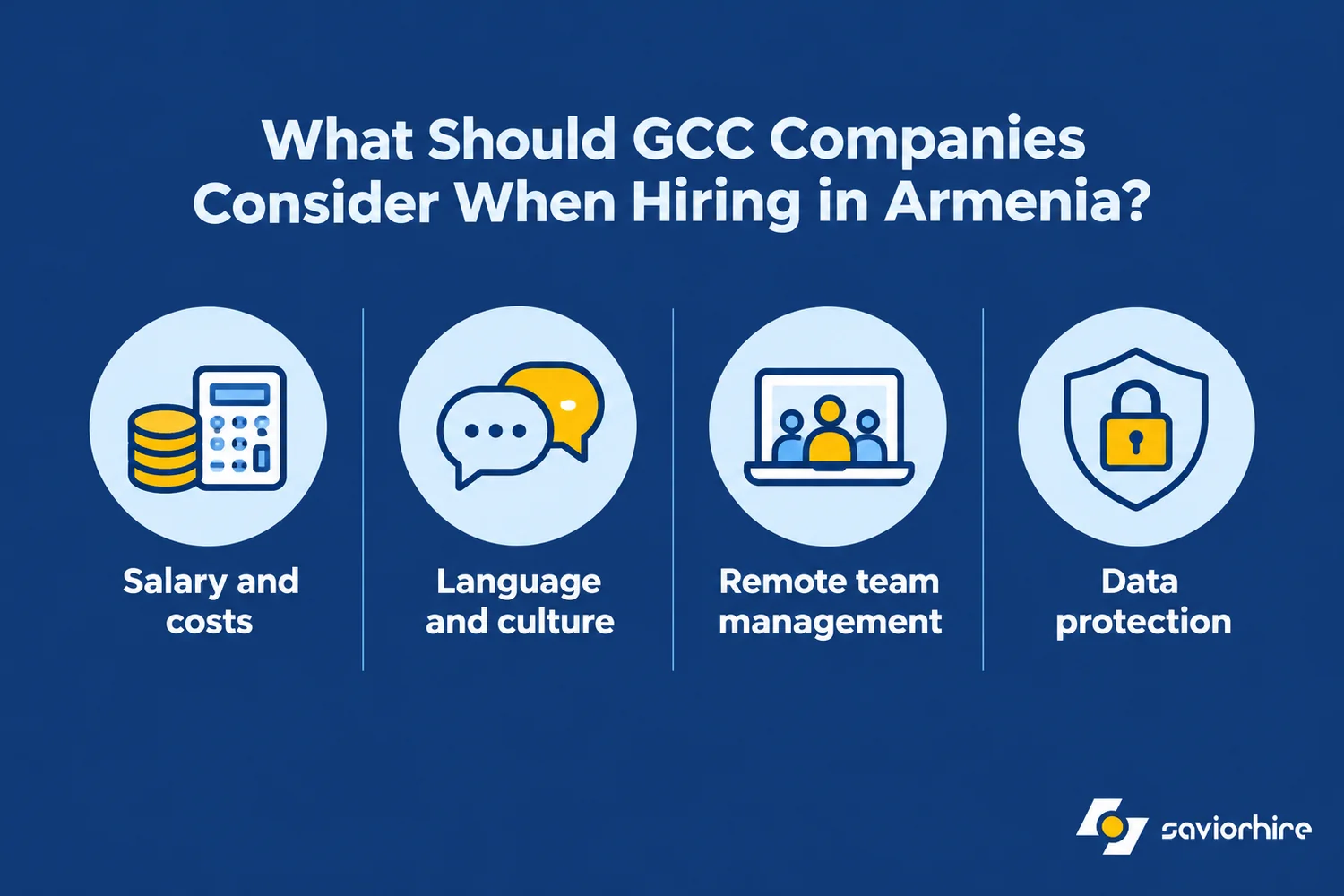
Beyond the legal rules, a few practical points shape how well your Armenian team works with your GCC office:
Armenia began work on data protection reform in 2025, so check for new rules before you set up cross-border data flows. Use non-disclosure agreements (NDAs) and IP clauses as standard for every hire.
At SaviorHire, we're a Yerevan-based team that helps companies build and grow teams in Armenia. Our services include tech recruitment, executive search, staff augmentation, EOR and payroll, and HR support services. We also help with branch office setup and the legal and banking steps that come with it.
We match our support to the route you choose. Recruitment finds the right people, and EOR lets you employ them without an entity. Staff augmentation helps you scale tech teams quickly. We have more than 50,000 pre-screened specialists and more than 2,000 placed candidates over more than five years, and we usually fill a position in one to two weeks.
If you're planning to hire in Armenia, contact SaviorHire to discuss EOR, recruitment, or staff augmentation options for your team.
Can a UAE company hire employees in Armenia without opening a local company?
Can Saudi Arabian companies employ remote workers in Armenia?
How much does it cost to hire an employee in Armenia?
Do foreign companies have to pay Armenian payroll taxes when hiring locally?
Can GCC companies hire Armenian software developers remotely?
How long does it take to hire an employee in Armenia?
What is the difference between an EOR and a recruitment agency?
Can a GCC company transfer an existing employee to Armenia?

Hamlet Mirzoyan
Tech & iGaming Recruitment Expert, CEO of SaviorHire
Hamlet Mirzoyan
Tech & iGaming Recruitment Expert, CEO of SaviorHire
Hamlet Mirzoyan helps companies in the tech industry build strong and high-performing teams. With over a decade of experience in technical recruitment, he shares insights on hiring trends, talent strategies, and industry updates through the SaviorHire blog.
Need to hire faster?
Let’s talk