


Table of Contents

Armenia has become a popular destination for international companies looking to hire skilled talent, particularly in the technology sector. One of the reasons is its relatively straightforward tax system, which is easier to navigate than many other jurisdictions.
However, employers still need to understand their payroll obligations before hiring employees in Armenia. These include personal income tax withholding, pension contributions, military stamp duty, and the country's mandatory health insurance requirements.
In this guide, we'll explain how the Armenian income tax system works and what employers need to know to stay compliant in 2026.
Armenia applies a flat 20% personal income tax on employment income. Unlike progressive tax systems, the rate does not change based on earnings. Employees are taxed at the same 20% rate regardless of their salary level.
Tax residency determines which income is subject to taxation. Armenian tax residents generally pay tax on their worldwide income, while non-residents are taxed only on income earned from Armenian sources. Residency is typically determined based on whether an individual spends at least 183 days in Armenia during a 12-month period.
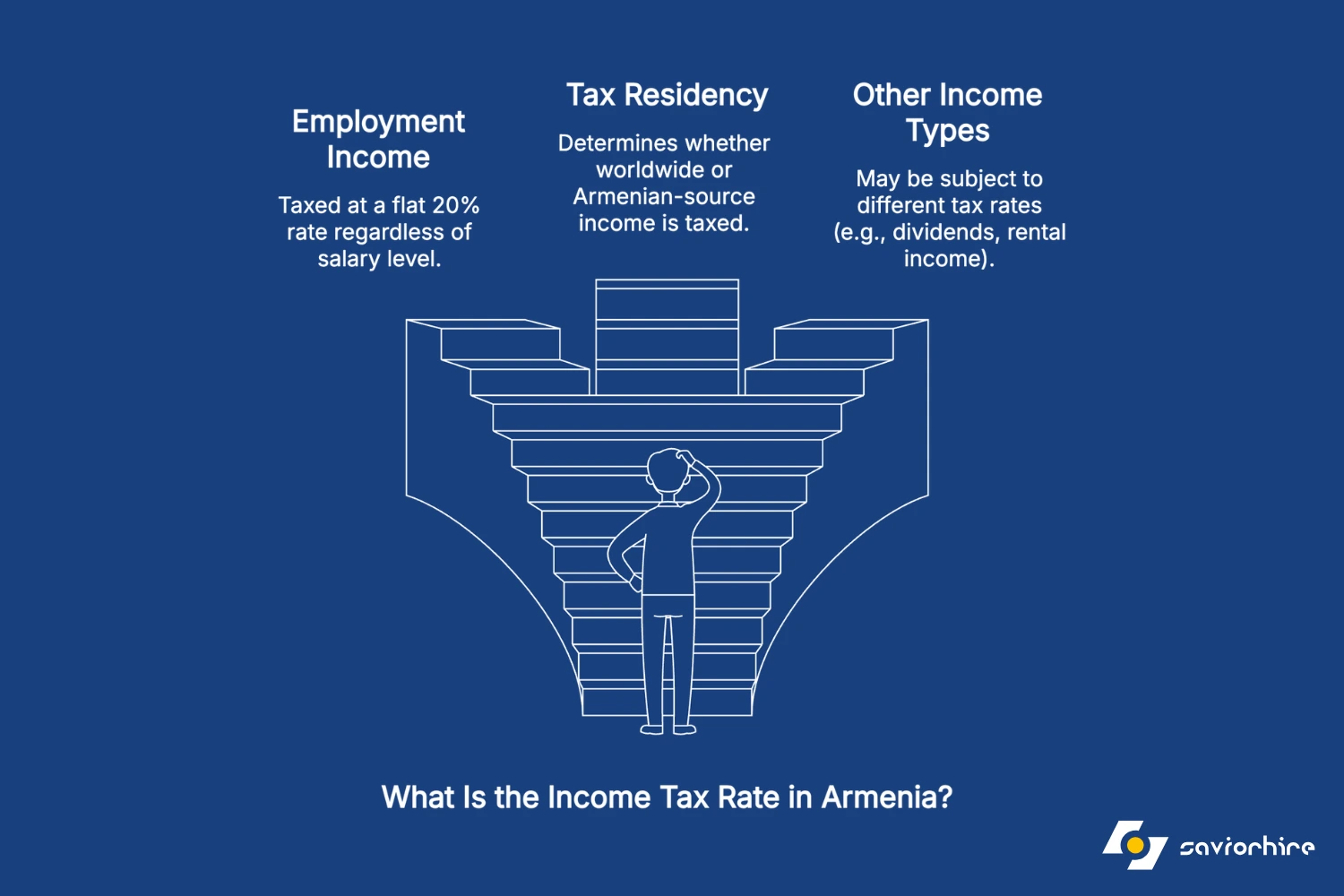
It is also worth noting that different types of income may be subject to different tax rates. For example, dividends, rental income, and interest income may be taxed separately from employment income under Armenia's tax rules.
In Armenia, employers are responsible for calculating, withholding, and remitting payroll taxes on behalf of their employees. This means the employer acts as the tax agent and handles all required deductions before salaries are paid.
One advantage for employers is that Armenia does not impose a separate employer income tax on salaries. Instead, employers are responsible for withholding and remitting:
Employers may also be required to make pension contributions on behalf of eligible employees.
Income tax is withheld directly from an employee's salary through the payroll process. The employer calculates the applicable deductions, applies the 20% income tax rate, and remits the withheld amount to the State Revenue Committee (SRC).
For example, if you take an employee on AMD 600,000 gross, their pension contribution comes to AMD 32,500, which leaves a taxable income of AMD 567,500. Apply 20% to that figure, and you withhold AMD 113,500 in income tax.
The sequence matters because applying 20% to the gross figure instead would over-tax your employee.
Payroll taxes and contributions must be reported and paid to the State Revenue Committee on a monthly basis. Employers are responsible for submitting the required payroll information and remitting withheld amounts within the applicable deadlines.
Failure to meet reporting or payment obligations may result in penalties and interest charges.
To remain compliant with Armenian employment and labor laws, employers should:
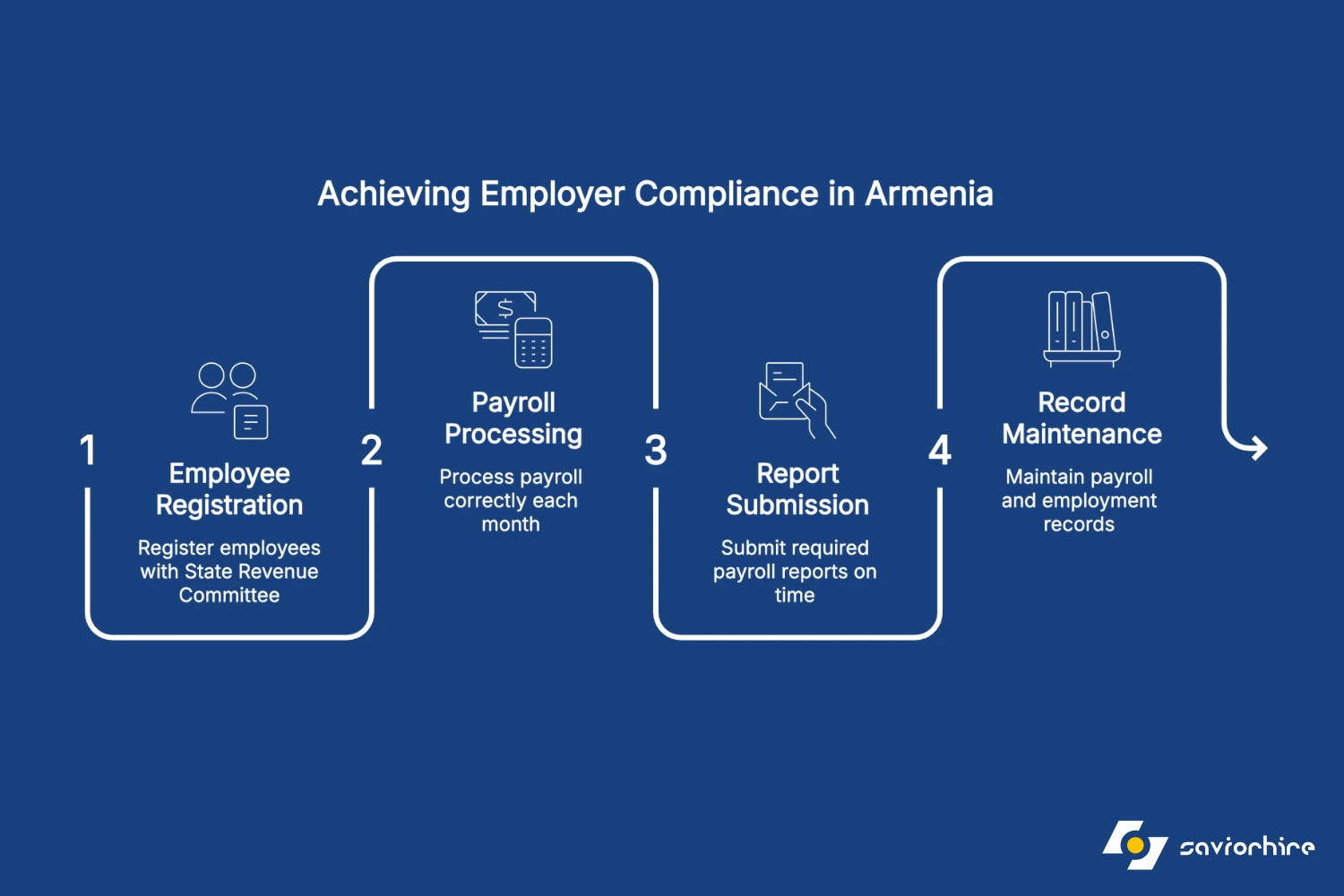
Many companies use local payroll providers or an Employer of Record (EOR) service to manage these obligations and reduce compliance risks when hiring in Armenia.
In addition to the 20% income tax, employers in Armenia must account for several other mandatory payroll deductions:
One reason many international companies hire in Armenia is that employer payroll costs remain relatively low compared to many European countries. Most statutory deductions are withheld from the employee's salary, helping employers keep payroll expenses more predictable.
Even so, businesses should account for pension obligations, payroll administration, and ongoing compliance requirements when budgeting for new hires.
This is much cleaner, easier to scan, and keeps the article moving. You can save the detailed rates and calculations for a table or FAQ later if needed.
If you establish a local entity in Armenia, you'll also need to account for corporate income tax (CIT). The standard corporate income tax rate is 18% of net taxable profit, including capital gains. This applies to Armenian resident companies on their worldwide income and to foreign companies operating through a Permanent Establishment (PE) on their Armenian-sourced income.
A few key points to keep in mind:
It is also important to separate corporate tax from payroll tax obligations. Corporate income tax applies to company profits, while payroll taxes apply to employee compensation and are withheld through payroll.
For compliance purposes, payroll taxes are reported and paid monthly, while corporate income tax advance payments are generally due quarterly, with the annual corporate income tax return due by April 20 of the following year.
Armenia offers several tax incentives that can significantly reduce costs for qualifying businesses, particularly in the technology sector.
If you're evaluating Armenia as a hiring destination, it's important to look beyond the income tax rate alone. Total employment costs depend on both employee taxes and employer contributions.
For many international employers, Armenia's appeal lies not just in its flat tax system, but in the combination of predictable payroll costs, a skilled workforce, and relatively low employer contributions.
Armenia's tax system is relatively straightforward, but foreign employers can still run into compliance issues if payroll is not managed correctly. Some of the most common mistakes include:
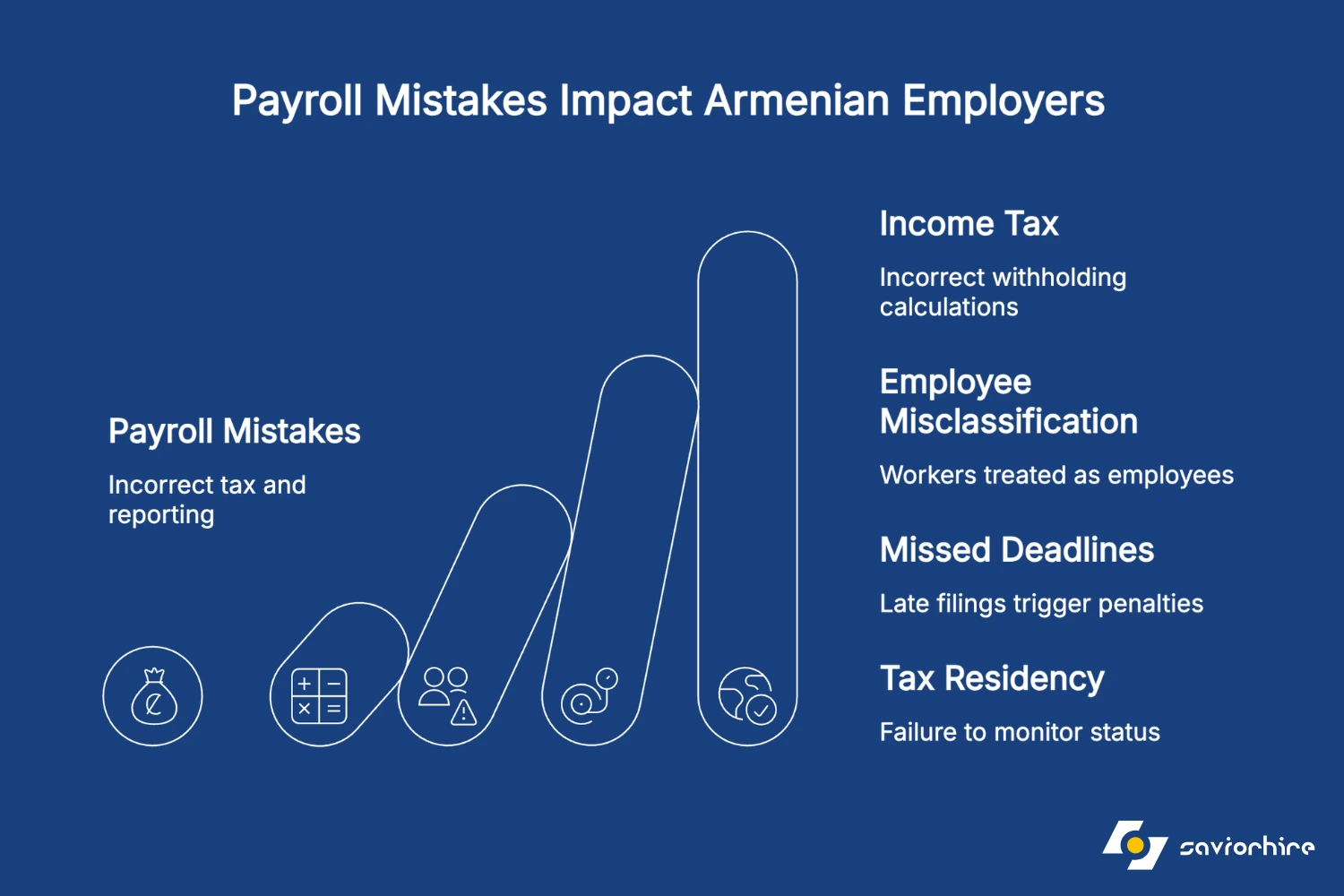
Taking a proactive approach to payroll compliance can help employers avoid costly mistakes.
Managing payroll and tax compliance in a new market can be time-consuming, especially when you're hiring across borders. SaviorHire helps companies navigate Armenia's employment and tax requirements by handling payroll processing, mandatory tax withholdings, pension contributions, and other statutory obligations.
We also support employers with worker classification, employment contracts, work permits, tax compliance, and ongoing payroll reporting, helping reduce administrative burden and compliance risk.
Whether you need payroll support or a full Employer of Record (EOR) service in Armenia, our team can help you hire and manage employees compliantly while staying focused on growing your business.
Looking to hire talent in Armenia? Contact SaviorHire to learn how we can simplify payroll, compliance, and workforce management.
What is the income tax rate in Armenia for employees?
Are employers responsible for withholding income tax in Armenia?
What payroll deductions must employers manage in Armenia?
Do foreign employees pay income tax in Armenia?
What are the employer payroll obligations in Armenia?
How often must income tax be reported and paid?
Are there double taxation agreements with other countries?
What is the easiest way for a company to manage taxes and payroll in Armenia?

Hamlet Mirzoyan
Tech & iGaming Recruitment Expert, CEO of SaviorHire
Hamlet Mirzoyan
Tech & iGaming Recruitment Expert, CEO of SaviorHire
Hamlet Mirzoyan helps companies in the tech industry build strong and high-performing teams. With over a decade of experience in technical recruitment, he shares insights on hiring trends, talent strategies, and industry updates through the SaviorHire blog.
Need to hire faster?
Let’s talk