


Table of Contents

US companies can hire employees in Armenia in two main ways: by establishing a local legal entity or partnering with an Employer of Record (EOR). An EOR acts as the local legal employer, handling employment contracts, payroll, and compliance administration while the US company manages the employee's daily responsibilities. This allows businesses to hire employees in Armenia without opening their own subsidiary.
This guide explains how US companies can hire employees in Armenia, including the available hiring models, a step-by-step process, Armenian employment laws, payroll obligations, hiring costs, and important considerations for US employers.
Most US companies hire in Armenia for tech talent at a lower cost than at home. Armenia's high-tech sector had 10,778 active companies and 41,431 employees in 2025, and turnover rose 28% that year.
Pay is well below US levels. According to Vardanyan & Partners, the average ICT salary in 2025 was above AMD 820,000 per month (about USD 2,160). Although gross salary is typically the largest employment expense, US companies should also consider applicable statutory obligations, recruitment costs, employee benefits, payroll administration, and EOR or entity management fees when estimating their total hiring budget.
Plan for two limits before you commit:
Every employee in Armenia needs an Armenian legal employer. You can meet that rule directly or through a partner.
Avoid treating full-time, employee-like workers as contractors. Armenian courts look at who controls hours and tasks, not at the contract title, and reclassification brings back withholding.
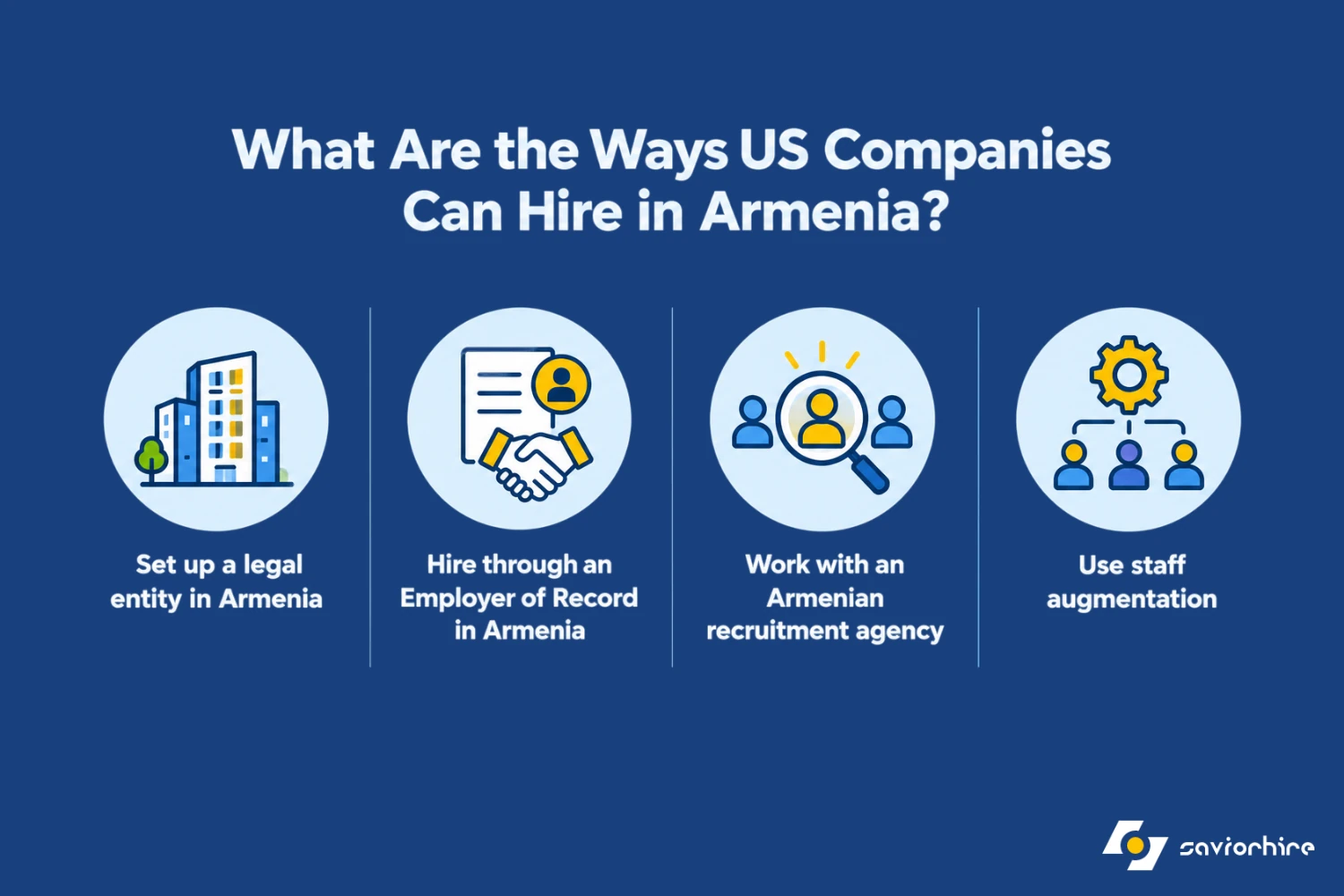
US companies can hire in Armenia through direct employment, an Employer of Record (EOR), or staff augmentation. The right option depends on your team size, hiring timeline, and whether you plan to establish a local entity.
An EOR suits companies that want to hire a small team without setting up a local entity. Direct hiring through an Armenian company may work better for larger teams or long-term operations, while staff augmentation helps you add engineers quickly.
EOR fees are usually charged monthly, so compare the costs against your planned salaries and team size. You can also compare global and local EOR services in Armenia before choosing a provider.
Yerevan is Armenia's main technology hub, with universities such as the National Polytechnic University of Armenia and the American University of Armenia contributing to the talent pool. The country has candidates for software development, data, and other engineering roles. Salary expectations vary by experience and specialisation.
You can find candidates through recruitment agencies, university networks, local tech events, and professional referrals. Assess technical skills, English proficiency for US-based collaboration, and the candidate's eligibility to work in Armenia.
Check which statutory contributions apply based on the employee's circumstances. If you're hiring a foreign national, additional work authorisation may be required. Review the requirements for getting a work permit in Armenia before finalising the hire.
Employees must have the required employment documentation in place before starting work. Contracts should cover the role, duties, salary, working hours, start date, probation period if applicable, and termination terms. Probation is optional and is generally limited to three months, subject to Armenian labour law.
Armenia is also moving towards electronic employment contracts. Before onboarding, confirm the current rules and implementation deadlines with your local provider to ensure the contract meets legal requirements.
Employers must calculate payroll, withhold applicable taxes and contributions, and submit the required reports to Armenia's State Revenue Committee (SRC). Depending on the employee's circumstances and the applicable rules, deductions may include income tax, pension contributions, military stamp duty, and health insurance contributions. Payment and reporting deadlines should be confirmed against current requirements.
An EOR can manage these payroll tasks, including salary payments, required filings, and employment records, so your US team doesn't have to handle Armenian payroll administration directly.
Prepare equipment, software access, security permissions, and onboarding documents before the employee's first day. Put remote or hybrid work arrangements in writing and agree on meeting times that work across US and Armenian time zones.
If employee information will be shared with US-based HR systems, review the applicable data protection requirements and document the legal basis for transferring and processing that information.
US companies hiring employees in Armenia must follow Armenian employment law, even if the business operates from abroad. The Labour Code of Armenia sets out the rules for employment contracts, working hours, leave, termination, and employee protections. Unlike in the US, employment generally cannot be ended at will. Employers need a lawful reason to terminate an employment relationship.
The standard working week in Armenia is 40 hours. Overtime is subject to legal limits and must be compensated according to Armenian law. Employees are generally entitled to at least 20 working days of annual paid leave, while fixed-term contracts are permitted only in legally defined circumstances.
US employers should make sure contracts clearly state the employee's role, salary, working hours, leave entitlements, and termination conditions.
Employers must calculate payroll, withhold applicable taxes and statutory contributions, and submit the required reports under Armenian law. The standard personal income tax rate is 20%.
Additional deductions or contributions may apply depending on the employee's circumstances and the rules in effect, including funded pension contributions, military stamp duty, and mandatory health insurance requirements. US companies should verify current rates, eligibility conditions, and reporting deadlines before onboarding employees.
Late payroll tax payments can result in penalties or interest. US companies should confirm current rates, contribution requirements, and payment deadlines before hiring.
Armenian law sets specific grounds and procedures for terminating employment. Depending on the reason for dismissal, employers may need to provide advance notice and severance pay. Unlawful dismissal can lead to legal claims, including reinstatement and compensation.
Additional protections apply in certain circumstances, including pregnancy and parental leave. Employers should check the applicable rules before making decisions that affect employees covered by these protections.
Armenia's personal data protection law applies to employee information, including identification documents, payroll records, and HR files. Employers need a lawful basis for processing this data and must follow applicable requirements when sharing it with overseas systems or service providers. Cross-border transfers may be subject to additional conditions.
US companies should also include appropriate confidentiality provisions in employment contracts and check that their HR systems and data-handling practices meet Armenian requirements.
The total cost of hiring an employee in Armenia depends on the position, experience level, employment model, and additional administrative expenses. Gross salary is usually the largest cost, but companies should also account for recruitment, payroll administration, employee benefits, and EOR or local entity expenses.
These are indicative salary ranges rather than guaranteed market rates. Actual compensation depends on technical specialization, seniority, and hiring conditions.
An EOR suits speed and small teams, while an entity suits long-term operations. The table below compares the two routes.Factor
The point at which establishing a local entity becomes more cost-effective depends on the number of employees, EOR service fees, payroll administration, accounting costs, and the company's long-term hiring plans. Many US companies begin with an EOR and consider establishing their own Armenian entity as their team grows.
Most risks come from small process errors, not from the law itself.
A local compliance partner can catch most of these before they cost you.
SaviorHire helps US companies hire employees in Armenia without managing every part of local recruitment and employment themselves.
Whether you're hiring your first employee in Armenia or expanding an existing technical team, SaviorHire offers recruitment, Employer of Record (EOR), payroll, and staff augmentation services tailored to your hiring needs.
Our services include:
With SaviorHire managing the local employment administration, your US team can focus on onboarding, collaboration, and business operations.
With more than 100 partners, SaviorHire helps US businesses build and expand their technical teams in Armenia. Book a consultation to discuss your hiring needs and understand the cost of hiring employees in Armenia.
Can a US company hire an employee in Armenia without opening a local entity?
Can US companies hire Armenian employees remotely?
Do US companies need an Employer of Record to hire in Armenia?
What taxes must employers pay when hiring employees in Armenia?
How long does it take to hire an employee in Armenia?
Is it better to use an EOR or establish a company in Armenia?

Hamlet Mirzoyan
Tech & iGaming Recruitment Expert, CEO of SaviorHire
Hamlet Mirzoyan
Tech & iGaming Recruitment Expert, CEO of SaviorHire
Hamlet Mirzoyan helps companies in the tech industry build strong and high-performing teams. With over a decade of experience in technical recruitment, he shares insights on hiring trends, talent strategies, and industry updates through the SaviorHire blog.
Need to hire faster?
Let’s talk