


Table of Contents

Saudi Arabia is in the middle of a massive tech build-out. Vision 2030 has poured money into digital transformation, and the market shows it. The Saudi ICT sector was worth $65.45 billion in 2026 and will likely hit $101.3 billion by 2031.
Demand for developers is growing faster than the market can supply it. So, if you want to hire software developers in Saudi Arabia right now, you're competing in a tight market, and Saudization rules decide who you can bring on and how fast.
In this guide, we’ll walk you through the hiring process in Saudi Arabia step by step, the types of developers you can bring on and where to find them. You’ll also learn how to avoid the common mistakes that companies make and how the costs in Saudi Arabia compare with the rest of the GCC.
Hiring tech talent in Saudi Arabia is easier when you follow a structured recruitment process instead of reacting each time a vacancy opens. These six steps can help you find the right people faster while staying aligned with local hiring requirements.
Before you post anything, get specific about the tech stack, the seniority level, and what the person will actually do day to day. A backend engineer with experience in Node.js and AWS requires a very different search from someone specialising in Java and enterprise systems.
It's also important to separate “essential” skills from those that are simply "preferred." When a job description tries to describe three roles at once, you get a flood of mismatched applicants and a hiring team that can't agree on who's actually a fit. Focus on the must-haves, and everything else will move faster.
In Saudi Arabia, employers typically hire from three talent pools: Saudi nationals, professionals already based in the GCC, and international candidates relocating to the Kingdom.
Each option has different advantages:
The right approach depends on the role, your hiring timeline, and your workforce planning. Many Saudi employers combine local and international recruitment to balance compliance requirements with access to specialised technical skills.
Many employers in Saudi Arabia combine permanent and flexible hiring models to balance project demands, costs, and Saudization requirements.
Different roles require different sourcing strategies.
For highly specialized roles in AI, cloud, cybersecurity, or fintech, relying on a single hiring channel is rarely enough. Combining multiple sourcing methods usually leads to a stronger shortlist and a faster hiring process.
A strong CV does not always translate into strong technical ability. Before making an offer, assess candidates through coding tests, technical interviews, system design exercises, or other practical assessments that reflect the work they'll actually be doing.
It's equally important to consider how well a candidate fits your team and the role. Depending on your industry, experience working with Arabic-language products, local regulations, or Saudi business environments may be an advantage. Looking at both technical capability and overall fit helps reduce the risk of a poor hire.
In Saudi Arabia's competitive tech market, lengthy hiring processes often result in losing qualified candidates. Keep interview stages focused, involve key decision-makers early, and provide timely feedback after each stage.
If you're hiring internationally, maintain regular communication throughout the visa and iqama process. Relocation can take several weeks, and keeping candidates informed helps maintain engagement and reduces the risk of them accepting another offer before joining your team.
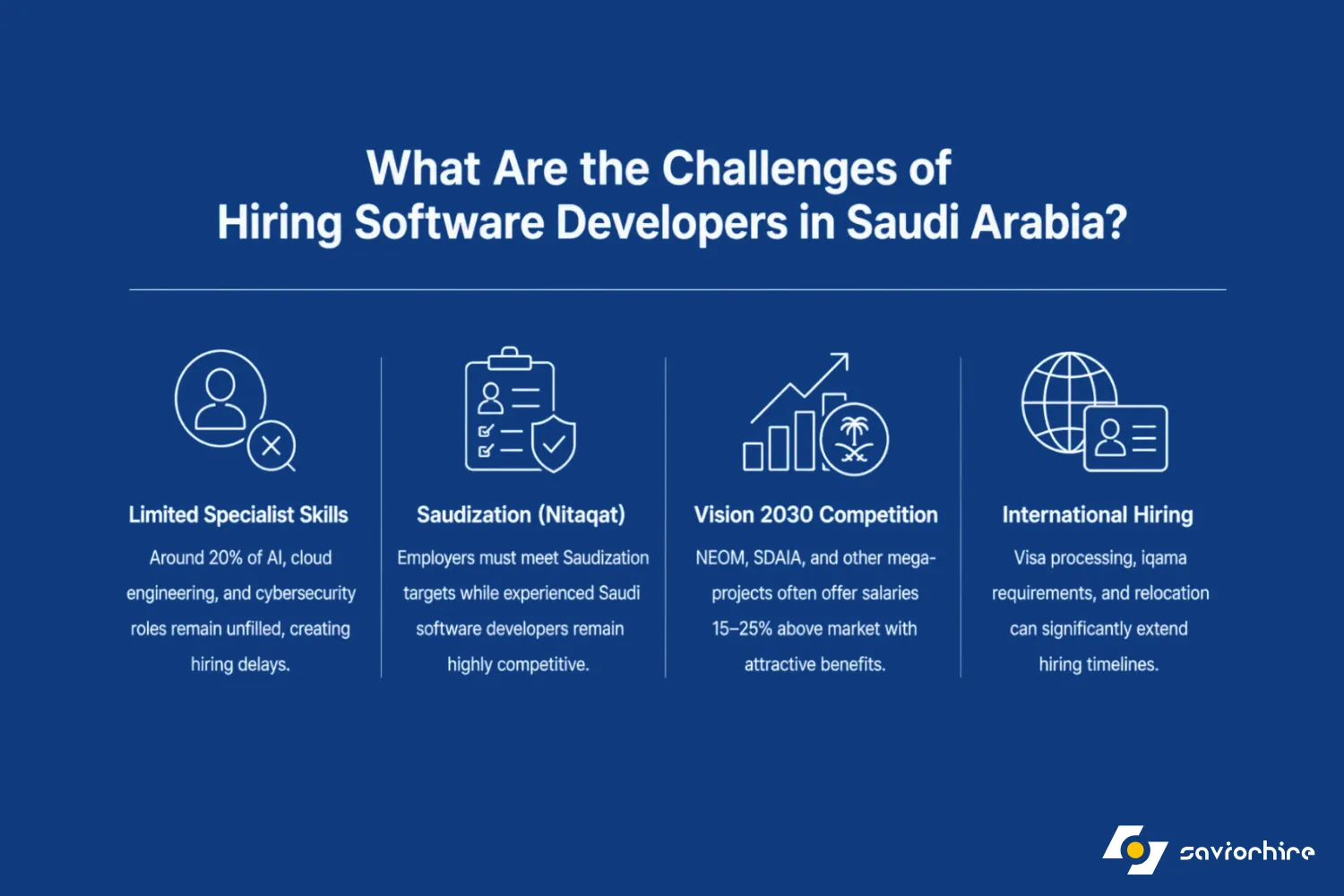
Hiring software developers in Saudi Arabia comes with several challenges, particularly for companies looking for experienced or highly specialized talent.
Planning ahead and using multiple sourcing strategies can help companies overcome these challenges and secure skilled developers more efficiently.
Saudi Arabia's tech talent market covers a wide range of software development specializations. While demand varies by industry, these are some of the most sought-after roles.
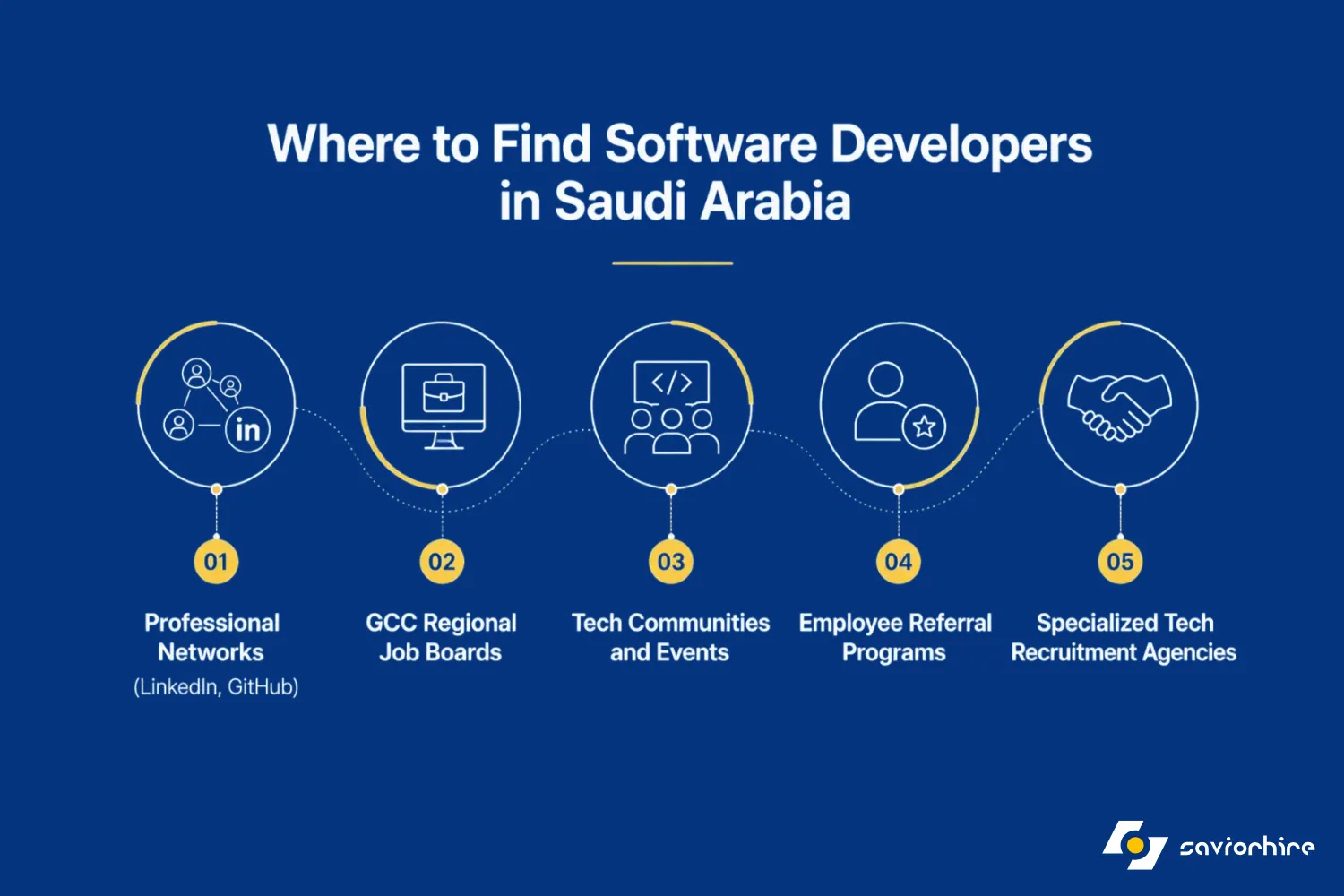
Knowing the channels, and when to lean on each one, saves you a lot of wasted effort. Here's where employers have the most luck.
Many hiring delays and unsuccessful offers can be traced back to a few common mistakes.
Companies comparing GCC markets usually consider three factors: salary expectations, available talent, and how easy it is to build a long-term technical team.
Saudi Arabia and the UAE are the two largest technology hiring markets in the GCC. Looking at software developer salaries in Saudi Arabia, a senior Python developer in Riyadh typically earns around AED 24,000 to 35,000 per month, while similar software development salaries in the UAE may range between AED 25,500 and 40,000 per month.
The UAE has a more mature technology ecosystem, with strong talent availability in areas such as fintech, AI, and cloud computing. Saudi Arabia, however, has seen rapid growth in demand due to Vision 2030, government digital initiatives, and large-scale projects that require experienced technical teams.
Qatar has a smaller technology market compared with Saudi Arabia and the UAE, but it continues to invest in digital transformation across sectors such as government, finance, and energy.
For companies hiring developers, Qatar can offer access to experienced professionals, particularly in enterprise and infrastructure-focused roles. However, the overall talent pool is smaller, which can make hiring specialised software engineers more challenging.
Kuwait generally has lower salary expectations compared with Saudi Arabia and the UAE, making it an attractive option for companies focused on cost efficiency.
However, its technology ecosystem is smaller, and the availability of senior developers in areas such as AI, cloud, and cybersecurity can be more limited. Companies looking to build large engineering teams may find Saudi Arabia offers a deeper talent market.
Bahrain has positioned itself as a growing fintech hub, supported by initiatives such as Bahrain FinTech Bay and a business-friendly regulatory environment.
It can be a strong option for fintech startups and smaller teams, but the available pool of software engineering talent is smaller than in Saudi Arabia. Companies requiring large-scale hiring or specialised technical teams may need to expand their search regionally.
Oman's technology sector is developing steadily, with growing investment in digital transformation and government technology projects. Operating costs can be lower than in larger GCC markets, but the local pool of experienced software developers remains more limited.
For companies prioritising access to a larger technical workforce, Saudi Arabia offers a broader hiring market.
The right choice depends on your goals. The UAE remains a strong option for companies seeking an established international tech ecosystem, while Saudi Arabia offers significant growth opportunities and access to a rapidly expanding technology market.
Smaller GCC markets such as Bahrain, Kuwait, and Oman may suit specific projects but often require more targeted sourcing strategies.
Hiring software developers in Saudi Arabia requires more than posting a job opening and waiting for applications. Companies need access to specialized talent, accurate market knowledge, and a recruitment process that can keep pace with a competitive hiring environment.
SaviorHire provides tech recruitment services in Saudi Arabia, helping companies source and hire software engineers and other technical professionals across different areas, including backend development, cloud engineering, AI, cybersecurity, and more. Our team handles candidate sourcing, technical screening, and shortlist preparation to help employers focus on the strongest matches for their roles.
We support companies at different stages of growth, from startups building their first engineering teams to established organizations expanding their technology capabilities. By combining recruitment expertise with an understanding of the Saudi tech market, we help businesses hire the right developers more efficiently.
If you're ready to build or grow your development team in the Kingdom, talk to our hiring team and we'll figure out what makes sense for you.
How can you hire software developers in Saudi Arabia?
What is the fastest way to hire developers in Saudi Arabia?
Where can you find software developers in Saudi Arabia?
How much does it cost to hire a software developer in Saudi Arabia?
Should you hire software developers locally or remotely?
What technical skills are most in demand in Saudi Arabia?
Are recruitment agencies useful for tech hiring in Saudi Arabia?
How long does it take to hire a developer in Saudi Arabia?
What are common hiring challenges in Saudi Arabia's tech market?
Can startups easily hire developers in Saudi Arabia?

Hamlet Mirzoyan
Tech & iGaming Recruitment Expert, CEO of SaviorHire
Hamlet Mirzoyan
Tech & iGaming Recruitment Expert, CEO of SaviorHire
Hamlet Mirzoyan helps companies in the tech industry build strong and high-performing teams. With over a decade of experience in technical recruitment, he shares insights on hiring trends, talent strategies, and industry updates through the SaviorHire blog.
Need to hire faster?
Let’s talk